From the Masonic Trowell
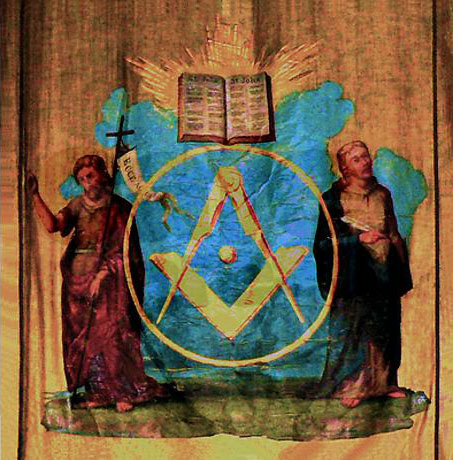
By history, custom, tradition and ritualistic requirements, the Craft holds dear the days of St. John the Baptist on June 24, and St. John the Evangelist on December 27. A lodge which forgets either forfeits a precious link with the past and loses an opportunity for the renewal of allegiance to everything in Freemasonry symbolized by these Patron Saints. No satisfactory explanation has as yet been advanced to explain why operative Masons adopted two Christian saints, when St. Thomas, the patron of architecture and building, was AVAILABLE.
Most Freemasons are AGREED that the choice of our ancient brethren was wise. No two great teachers, preachers, wise men, saints, could have been found who better showed in their lives and works the doctrine and teachings of Freemsonry.
St. John the Evangelist apparently came into our fraternal system somewhere towards the close of the sixteenth century; at least, we find the earliest authentic lodge MINUTE reference to St. John the evangelist in Edinborough in 1599, although earlier mentions are made in connection with that may be called relatives, if not ancestors, of our Craft. For instance “The Fraternity of St. John” EXISTED in Cologne in 1430. “St. John’s Masonry” is a distinctive term for Scotch Lodges, many of the older of which took the name of the saint. Thus, in its early records, the Lodge of Scoon and Perth is often called the Lodge of St. John, and the Lodge possesses a beautiful mural painting of the-saint, on the east wall of the lodge room.
Other Lodges denominated “St. John’s Lodges” were some of those unaffiliated with either the “Moderns” or the “Ancients” in the period between establishment of the Ancients (1751) and the Reconciliation (1813).
In many old histories of the Craft is a quaint legend that St. John the Evangelist became a “Grand Master” at the age of ninety. It seems to have its origin in a book printed in 1789, in which one Richard Linnecar of Wakefield wrote certain “Strictures on Freemasonry,” although his paper is really an eulogy. Whether this writer really CONTINUED a tradition, or invented the tale which was seized upon by Oliver and kept alive as a legend, impossible though it is, no man may say.
One Grand Lodge has ruled that Sts. John’ Days are Landmarks! Of course any Grand Lodge may make it’s own laws, but it is beyond the power of any Grand Lodge either to make a Landmark by pronouncement, or to unmake a Landmark by denying it. Inasmuch as Landmarks are universally admitted to be handed down to us from “time immemorial”, and Sts. Johns’ Days as Masonic festivals, are neither extremely old nor universal among the Craft (England using Wednesday after St. George’s day; Scotland St. Andrew’s Day; and Ireland St. Patrick’s), we must consider only that Grand Lodge’s intent to honor our patron saints, and not the VALIDITY of her results.
Historians believe that only after 1717, when the Mother Grand Lodge was formed, did Freemasons generally hold festival meetings on either or both June 24 and December 27.
Here are two ADDRESSES, either of which is appropriate to either June 24 or December 27, and a Masonic story, which, if well read by some brother with some elocutionary training, is also appropriate and informative:
St. Johns’ Days
The real explanation of Freemasonry’s CONNECTION with the Sts. John is not to be found in the history of the Craft, but in the history of religions. For the festival days of the two Sts. John are as old as the ancient systems of worship of fire and sun.
Travel backwards in imagination to an unknown date when the world of men was young; when knowledge did not EXIST and the primal urges of all humanity were divided between the satisfaction of bodily needs -hunger, thirst, warmth, light and the instincts of self-preservation, mating, and the love of children. The men of that far off age found everything in nature a wonder. They understood not why the wind blew, what made the rain, from whence came lightning, thunder, cold and warmth; why the sun climbed the heavens in the morning and DISAPPEARED at night, or what the stars might be.
All primitive people tried to explain mysteries in terms of their daily lives. When angry their emotions resulted in loud shouts and a desire to kill. What more natural than to think thunder and lightning the anger of the Unknown who held their lives and well being in His hands? Ancient man bundled the enemy he conquered out of his cave into the OPEN, where he froze or starved or was eaten by beasts. What more natural than to think the wind, the rain, the cold, a manifestation of an angered Unseen Presence?
The greatest manifestation of nature known to our ancient ancestors was the sun. It was always present during the day, and its near kin, fire, warmed and comforted them at night. Under its gentle rays crops grew and rivers rose.
The sun kept away the wild beasts by its light. The sun made their lives possible. Sun worship and fire worship were as natural for men just struggling into understanding as the breath they drew.
Early recognized facts must have been the sun’s SLOW travel from north to south and back again as the seasons waxed and waned. And so mid summers day, the longest, became a festival; it was the harbinger Or harvest, the birthday of new life, as the winter solstice was significant of the end of the slow decline of the sun, the BEGINNING of a new time of warmth and crop and happiness.
Through countless years, in a thousand religious, cults, mysteries, in a hundred climes and lands, priests and people celebrated the solstices. We know it not only from history and the records of ancient peoples, often cut upon stone, but from myths and legends; the story of Ceres and her search for her daughter Proserpine the allegory of Isis, Osiris and Horus.
Ancient custom is taken from a people with difficulty. Even today we retain customs the origin of which is lost to most of us. We speak glibly of Yuletide at Christmas, without thinking of an ancient Scandinavian god, Juul. The small boy avers truth “By Golly!” not knowing that he OFFERS his hand (gol) if he speaks not the truth. Those who think it “bad luck” to break a mirror only CONTINUE a savage belief that a stone thrown in water which mirrors the face of an enemy will break his heart even as the reflection is broken.
If such ideas persist to this day, imagine how strenuously a people would resist giving up a holiday celebration which their fathers’ and their fathers’ fathers before them had kept for untold ages.
So it was when Christianity came to the world. Old feasts and festival days were not lightly to be given up, even by those who put their faith upon a Cross. Hence clever men in the early days of Christianity turned the pagan festivals to Christian usage, and the old celebrations of summer and winter solstice became the Sts. Johns’ Days of the Middle Ages.
As the SLOW years passed, those who celebrated thought less and less of what the days really commemorated, and became more and more convinced of their new character. Today, hardly a Freemason gives a thought to the origin of St. John’s Day in Winter, or knows his celebration of St. John’s Day in midsummer preserves a touch with cavemen ancestors.
It was a common custom in the middle Ages for craftsmen to place themselves under the protection of some saint of the church. All the London trades appear to have ranged themselves under the banner of some saint and if possible they chose one who bore fancied relation to their trades Thus the fishmongers adopted St. Peter; the drapers chose the Virgin Mary, mother of the ‘Holy Lamb’ or ‘Fleece’ as an emblem of that TRADE. The goldsmiths’ patron was St. Dunstan, represented to have been a brother artisan. The merchant tailors, another branch of the draping BUSINESS, marked their connection with it by selecting St. John the Baptist, who was the harbinger of the Holy Lamb’ so adopted by the drapers. Eleven or more of the guilds had John the Baptist as To say with certainty why Freemasons adopted the two Sts. John, and CONTINUE to celebrate days as PRINCIPAL feasts which were once of a far different significance, is not in the power of any historian as yet. But the fitness of these two is obvious in our system if we consider the spiritual SUGGESTION of their lives.
St. John the Baptist was a stern and just man; intolerant of sham, of pretense, of weakness; a man of strength and fire, uncompromising with evil or expediency, and yet withal courageous, humble, sincere, magnanimous. A character at once heroic and of rugged nobility, of him the Greatest of Teachers said: “Among them that are born of woman, there hath not arisen a greater than John the Baptist.”
Of St. John the Evangelist, the disciple whom Jesus loved, a thousand books have been written, and student has vied with minister, TEACHER with historian, to find words fitly to describe the character of the gentle writer of the Fourth Gospel.
No attempt at rivalry will here be made; suffice it that St. John the Evangelist is recognized the world over as the apostle of love and light, the bringer of comfort to the grief-stricken, of courage to the weak, of help to the helpless, of strength to the falling.
Freemasonry is wise in a gentle wisdom which passeth that in books when she takes for her on both the saint who foretold the coming and the saint who taught the law of the Son of Man who walked by Galilee.
The question “From whence come you?” and the answer “From the Lodge of the Holy Sts. John at Jerusalem’, has puzzled many. None have phrased the simple, explanation of the inner meaning of this with more beauty and clarity than Brother Joseph Fort Newton, he of the golden pen and the voice of music:
“There is no historical evidence that either of the two Saints of the church were ever members of the Craft. But they were adopted as its patron Saints, after the manner of former times a good manner it is, too- and they have remained so in Christian lands. Lodges are dedicated to them, instead of to King Solomon, as formerly.
“So, naturally, there came the idea, or ideal, of a sacred lodge in the Holy City presided over by the Saints John. No such lodge ever EXISTED in fact, and yet it is not a fiction -it is an ideal, and without such ideals our life would be dim and drab. The thought back of the question and answer, then, is that we come from an ideal or Dream Lodge into this actual workaday world, where our ideals are to be tested”.
We do not know just when, or just how, Freemasonry adopted the Sts. John.
Their days are the Christian adaption of pagan festivals of a time when man, knowing no better, worshipped the sun as the supreme God. So when we celebrate our festival days on June 24 and December 27, we walk STEP by step with ancient ancestors, worshipping as they worshipped, giving thanks as they did; they to the only god they knew for the glory of summer, the BEGINNING of the period when days lengthened- we to the G.A.O.T.U., That our gentle Craft took for its own the austere but loving characters of two among the greatest of the saintly men who have taught of the Father of all mankind.
 Unity Lodge No. 146
You must be logged in to post a comment.