Brethren,
I had been wondering what to speak to you about for this July Trestle board for some time. I knew that I wanted to talk on the subject of Friendship, Morality and Brotherly Love in honor of the Grand Master’s official visit to our district this month, but I was unsure of how to approach the subject. Then as most things happen, as I had put aside my predicament all together, inspiration struck.
My wife and I have had a tradition with our sons that during their summer vacation, we like to take one or two day “day trips” to various locations in the surrounding area. Being here in the Shenandoah Valley, you can travel for 1 -2 hours in pretty much any direction and arrive at a historically significant location. We normally try to prepare the boys for our trips by reading books or watching movies so that they may have a way into where we are visiting. So as our tradition has it, last weekend we watched a movie about where we were going to be traveling. It is a great movie full of inspiring speeches, seemingly larger than life fights and plenty of humor and action. However, my favorite part had always been a side story within the story. This was a story of two best friends. They had been friends for many years, but now found themselves on opposite sides of the battle line. I have heard this story of the two men several times and have even spoken to my boys about them. I have always seen this friendship as a representation of the entire conflict and wanted to share it with you and perhaps dig a little deeper.
156 years ago the Battle of Gettysburg was fought from July 1st to July 3rd. I am sure that you are all well aware of this battle, the significance of it during the Civil War and the various events that occurred across the three days. I am also sure that some of you have even now guessed to the identities of the two friends of which I spoke of before, but there is more to the story than I first thought. I would like to bring your attention to the third day of battle, July 3rd 1863 and the infantry charge now known as Pickett’s Charge. The two friends were Army of the Potomac’s II Corps Commander, Major General Winfield Scott Hancock and Army of Northern Virginia Brigade Commander, General Lewis “Lo” Addison Armistead.
Generals Armistead and Hancock were the best of friends, you would say that they were like brothers, and both served together in the Army stationed in California. When the Civil War broke out, General Armistead could not bear to take arms against his fellow Virginians and therefore resigned his commission in the United States Army. Although they were on opposite sides of the conflict, both men stayed apprised of the others location and health and both were happy that they had never had to directly fight against the other. That is until July 3rd, 1863.
On the afternoon of July 3rd, Lieutenant General James Longstreet gave the order for Major General George Edward Pickett’s Virginia Units to charge the center of the Union’s line along with units from North Carolina, Mississippi, Alabama and Tennessee. One of Pickett’s commanders – General Armistead. At the center of the Union line – the Army of the Potomac’s II Corps, commanded by General Hancock.
General Armistead was mortally wounded at the copse of trees just past the “bloody angle” or “high water mark.” He commanded one of the only units to break through the Union line. It is said that as he went down he was heard to call out for help “as the son of a widow.” Many of the men of the near-by 69th Pennsylvania Volunteer Infantry rose up in the middle of the battle, leaving their place of cover, to go to the assistance of Brother Armistead (Alexandria-Washington Lodge No. 22). Captain Henry Harrison Bingham met Armistead on the field of battle and informed him that General Hancock had also been wounded that day. Being struck with grief, Brother Armistead entrusted personal letters and a watch which bore a square and compasses to Brother Bingham (Chartiers Lodge No. 297, Canonsburg, PA) to be given to his friend, his brother, Brother Hancock (Charity Lodge No. 190, Norristown, PA).
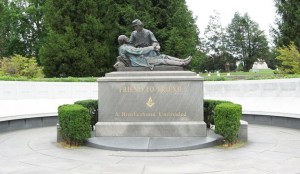
I cannot think of a better example of Friendship and Brotherly Love, than this story of two best friends and Brothers separated by duty, especially being very timely considering that it will be 156 years to the day of our July 2019 Stated Communication, or is there. I now ask that you not consider the story or actions of Brother Armistead, Brother Hancock or even Brother Bingham in this story.
Instead, let us think of the Brotherly Love shone by the men, the Brothers, of the 69th Pennsylvania Volunteer Infantry. Upon hearing the cry of a fellow Brother, unknown to them, an enemy just moments before leading men that were attempting to kill them, arose from behind protection in the midst of one of the bloodiest battles, in the bloodiest war to render aid and sustain a fallen Brother.
Sincerely & Fraternally,
Charles Taggart
Worshipful Master Unity 146
 Unity Lodge No. 146
You must be logged in to post a comment.