Slides: Power Point, Google Slides
Historical Notes of the region prior to Chester Lodge
Indigenous People
The area we know of today as Front Royal was originally inhabited by a Native American tribe known as the Manahoacs (Possibly absorbed into the Monacans). Of special note, Warren county is the home of the oldest known permanent habitation in the Paleo-Indian Period in the Eastern US and the oldest structure in North America at the Thunderbird Archaeological District near Limetown, VA with radiocarbon dating back to 9900 BP in the Archaic Period.
Treaties of Albany & Lancaster
1722 to 1744
Virginia Governor Alexandria Spotswood led the Knights of the Golden Horseshoe expedition through the Blue Ridge Mountains in 1716. In 1722, he led the English colonies into an agreement with the Five Nations (Mohawk, Oneida, Onondaga, Cayuga, and Seneca) of the Iroquois Confederacy to designate the Blue Ridge Mountains as the boundary between Virginia and Iroquois territories. This was done to minimize violence on the frontier during the war seasons each spring along the war-trails (the Great Warrior Path, later known as the “Great Road”, Valley Turnpike, and Route 11 today), allow settlement on the frontier, and prevent the French from settling in the land. However, tensions rose as settlers encroached across the Blue Ridge and into the Shenandoah Valley.
In 1743, the Iroquois sold their rights to any settled land in the Valley to Governor Sir William Gooch for 100 pounds sterling. In the following year, in the Treaty of Lancaster, they sold all remaining claims in the Shenandoah Valley for 200 pounds in gold.
Van Meter/Hite Grant
June 17, 1730
John Van Metre was known as an Indian Trader that explored the back-country of Virginia as early as 1725. Lord Fairfax asserted that he owned the entire lower Shenandoah Valley. John tried different options to acquire the land, including from the indigenous peoples. On June 17, 1730, John Van Metres petition was read to take up a tract of land on the West side of the Great Mountains for himself, eleven children, as well as relatives and friends in New York who wanted to move and settle in the same place. He was granted to select 10,000 acres between the North and South forks of the Shenandoah River for himself, and 20,000 acres to the West of the Shenandoah river, East of Opequon Creek, and South of the Potomac River to divide up as 1,000 acres per family as he saw fit within the next two years by Governor, William Gooch. This was a gamble that the Governor had the authority to issue patents. Lord Fairfax’s prices for parcels greater than 600 acres were equal to the cost of treasury rights sold by the colony – but he still charged for land. The governor sacrificed revenue of treasury rights.
At sometime a protest, on behalf of Lord Fairfax, was filed that the patents were not issued by the Colonial Government. Joist Hite, cousin to the Van Meter brothers, purchased the Van Meter’s rights for unpatened parcels on August 5, 1731 to eliminate confusion and competition with settlers surveying the lands prior to the Van Meter Grant. Williamsburg officials created a buffer zone of loyal citizens to provide military defense, compared to the revenue of 10 shillings for 100 acres.
Initial settlers erected single-room log cabins between 16-20 feet long with Clapboard roofs held in place by weight poles, and floors made of dirt or split puncheons smoothed with a broadaxe. Stone houses were built using local limestone and sometimes roofed with thatch.
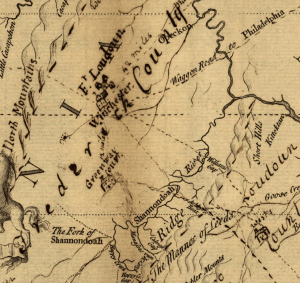
1736 & 1737
Library of Congress
Chester
October 19, 1736
Captain Thomas Chester is a founding father of Front Royal as one of the first settlers in the Shenandoah Valley from an area around Philadelphia, Pennsylvania. He was deeded 100 acres on the North side of the North river. He became a county Justice when Frederick county was first formed, and the second sheriff in the county. His wife, Sarah Cartmell, owned an Inn at one of the ferry landings.
He was granted a license to operate a ferry across the Sherrendo (Shenandoah) River from the land of William Russel at the mouth of Happy’s Creek, across into the fork on October 19, 1736. In older maps, we see “Chester” and “Chester’s Ferry” in the place of what is now known as the area of Riverton today. It was three pence for a man as well as for a horse. Similar to most ferries that we see in history, the trailhead of the most convenient path through the mountains (Gap) was named after the ferry as “Chester’s Gap”. The trail is known today as Route 22 today, which runs along Happy Creek and Sloan Creek. The primary road through Front Royals infancy is known today as “Chester Street”.
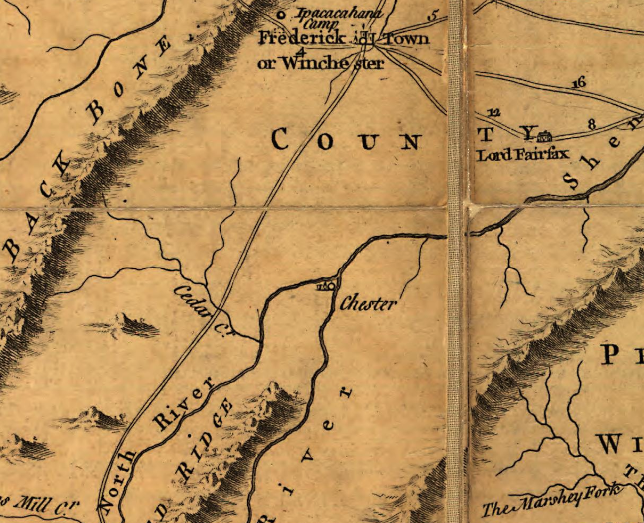
Frederick County
1738, 1743
Frederick County was formed by splitting Orange County in 1738. It was made official in 1743. It was named after Frederick Louis, Prince of Wales. The area has been referred to as “Old Frederick County”.
LeHewtown
1754
The area of downtown Front Royal was originally named LeHewtown by Peter LeHewe, who purchased 200 acres in 1754 and named it after himself. The property was along Happy Creek trail, now known as Chester Street, and was the primary street entering town for many years to come. This is the origin of the towns nickname “Hell Town” often used in the 1790’s and seen on some building names and phrases used today.
Declaration of Independence
August 2, 1776
Delegates began signing the Declaration of Independence at the State House (renamed to Independence Hall) in Pennsylvania, declaring the freedom of the thirteen colonies from Great Britain.
Virginia Joins the Union
June 25, 1788
On June 25, 1788, Virginia became the 10th colony to enter the union.
Front Royal
November 15, 1788
Front Royal was established by an Act of the General Assembly on 50 acres of land from the Van Meter Grant were laid out into lots and streets, of which the property owners at the time consisted of the following:
| George Chick | Solomon Van Meter | Henry Trout |
| William Cunningham | James Moore | Allen Wiley |
| Robert Haines | William Morris | Original Wroe |
| Peter Halley | John Smith |
Thomas Allen, Robert Russel, William Headly, William Jennings, John Hickman, Thomas Hand, and Thomas Buck were assigned as trustees.
At the time, it was hardly anything more than a hamlet. The area was referred to in French as “le front royal”. It had also picked up the unsavory name of “Hell-Town” (derived from Hewtown), due to shootings, brawls, and drinking. Some people refer to an incident of a colonial drilling his men to “Front the Royal Oak!” that caught on. Others say that the passwords “Front” and “Royal” were used to enter and leave the area. Last is simply that the English mimicked the French language by swapping words to be “Frontier Royal” instead of “The Royal Frontier”, which later became “Front Royal”.
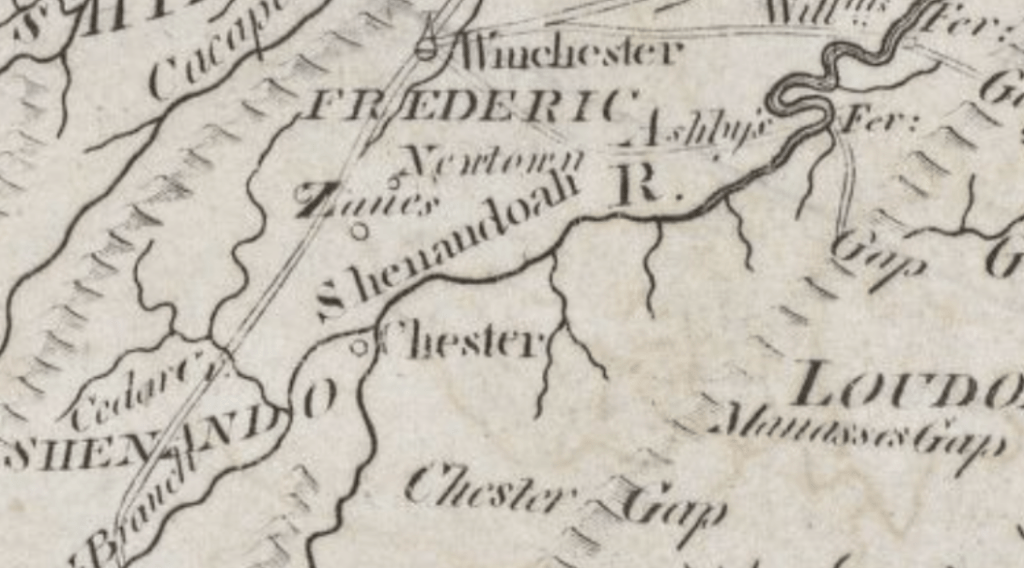
Samuel Lewis, 1794
American Geographical Society Library – Maps
University of Wisconsin Milwaukee
Chester Lodge No. 61
December 11, 1799 – 1804
The first Masonic Lodge of record in the Front Royal area was known as Chester Lodge No. 61 in Frederick County.
It is unknown exactly where this Lodge was located. The area of Riverton, where the North and South fork of the Shenandoah river meet and flow North towards Harpers Ferry, was the location often referred to as Chester, after Chester’s Ferry. A path led travelers through the Blue Ridge mountains along Happy Creek to the ferry, in which the trailhead was called “Chester’s Gap”.
A Master Mason certificate from Chester Lodge stated that the Lodge was in the town of Front Royal. It is now believed that the Lodge may have been situated on Chester Street, the main road that connected Chester Gap to the ferry, and ran through the center of town.
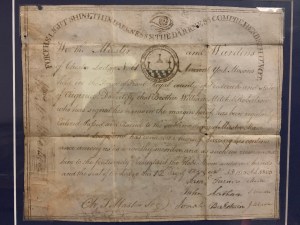
For the light shine, thin darkness & The darkness comprehendeth it not. We the Master and Wardens of Chester Lodge No. 61 Ancient York Masons held in the Town of Front Royal county of Frederick and state of Virginia; Do certify that Brother William Mitchel Robertson who has signed his name in the margin hereof has been regularly Entered, Passed, and Raised to the sublime degree of Master Mason in … Lodge and has conducted himself of deserving his contain… once among us, is a worthy member and as such ever recommend him to the fraternity throughout the globe. Herein under our hands and the seal of the Lodge this 12th day of August AD 1803 AL 5803. Samuel Turner, Master; John Lantham?, S Warden; Jorsh? Baldwin, J Warden; Ch. T. Mastin, Sec
Front Royal was still a recently established town 11 years prior. According to the records of the Grand Lodge of Virginia, Chester Lodge was chartered on December 11, 1799 along with a certificate from Winchester Lodge No. 12 – which was in the jurisdiction of the Grand Lodge of Pennsylvania. They also had a recommendation signed by several members from the Grand Lodge.
The first Worshipful Master was John Hickman. In 1804, the Lodge made its last Return to the Grand Lodge.
| Office | 1799 Charter Members | 1804 Last Return |
|---|---|---|
| Worshipful Master | John Hickman | Samuel Turner |
| Senior Warden | William Reynolds | John Latham |
| Junior Warden | Moses Payne | John Tuttle |
| Secretary | Charles R. Mastin | |
| Treasurer | John Hickman | |
| Senior Deacon | George Cooper | |
| Junior Deacon | Francis T. Mastin | |
| Steward | John Hickman | |
| Tyler | Hough McMellon |
Brethren in the last return consisted of the following:
| Past Masters | Master Masons | Fellowcrafts | Entered Apprentices |
|---|---|---|---|
| John Hickman | William Monroe | Robert Jones | William Moreland |
| Strauther G. Settle | William Wroe | ||
| Mason Pilcher | Andrew Turner | ||
| William Ash | John Jacobs | ||
| Vincent Haynes | John Jacobs | ||
| Samuel Shackleford | John Hamston | ||
| Robert Hereford | Isaac Henry | ||
| Robert Simpson | Daniel White |
War of 1812
June 1812 – February 1815
Alexander R. Newman had fought in the War of 1812 before he was initiated as a Mason at Front Royal Lodge No. 102 on October 10, 1818.
Front Royal Lodge No. 102
1816 – 1825, 1840 – 1857
New interest in Masonry awakened in 1816, and on February 14, 1816, a dispensation was granted to Front Royal Lodge No. 102 with Cyrus D. Baldwin as Worshipful Master. This Lodge was then chartered on December 10, 1816.
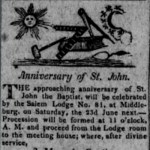
There are a few invitations found where Front Royal Lodge No. 102 was invited to Salem Lodge No. 81 on June 23, 1821. The event was quite a spectacle and invited good singers to come join and sing three hymns. The lodge was also invited to join Winchester at the dedication of their new Hiram Hall on June 24th, 1822.
The last Return from Front Royal Lodge No. 102 was made to the Grand Lodge in 1822. In 1824 it was reported that a former brother, Lewis Dover, was expelled for embezzling the funds of the Lodge. The Front Royal Lodge was declared extinct by the Grand Lodge in 1825.
Warren County
March 9, 1836

Warren Heritage Society
On March 9, 1836, Front Royal, which was in Frederick County, became the seat of the the newly established Warren County, made up from parts of Frederick and Shenandoah county. Court was first held in a local tavern before the court house was constructed in the same year. The old courthouse was torn down and rebuilt as part of the 1936 centennial.
The county was named after Dr. Joseph Warren Jr., a General who fought on the front lines with his troops at the Battle of Bunker Hill (the American Revolutions first major battle) and died while rallying his troops for a third wave against the British. At the time of his death, he was the Master of St. Andrews Lodge and recently appointed as the Grand Master of the newly formed Provincial Grand Lodge of Massachusetts.
Revival
1840-1857
Warren Heritage Society

Worshipful Master 1842-1844
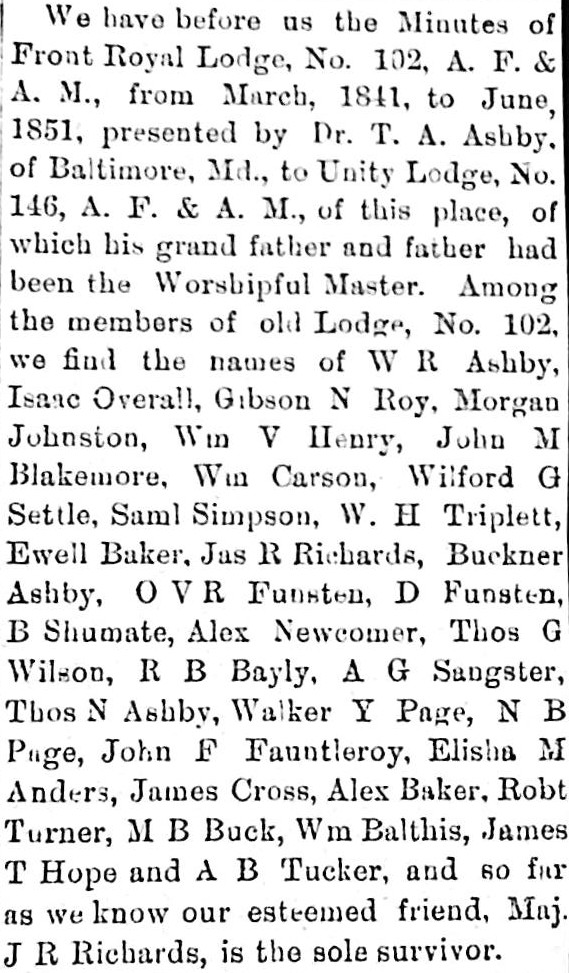
The Front Royal Lodge No. 102 was revived on December 15, 1840, and on March 30, 1841, meetings were resumed. The bylaws of Cassia Lodge No. 142 were adopted.
The lodge moved to a room over the store of William M. Buck for $25.00 yearly after a meeting on August 26, 1841.
| Elisha M. Anders | James Cross | James R. Richards |
| Buckner Ashby | John F. Fauntleroy | Gibson N Roy |
| Thomas N. Ashby | D. Funsten | A. G. Sangster |
| W. R. Ashby | O. V. R. Funsten | Wilford G. Settle |
| Alex Baker | James T Hope | B Shumate |
| Ewell Baker | Morgan Johnston | Saml Simpson |
| William Balthis | Alex Newcomer | Thomas G Wilson |
| R. B. Bayly | Isaac Overall | W. H. Triplett |
| M. B. Buck | N. B. Page | A. B. Tucker |
| William Carson | Walker Y Page | Robert Turner |
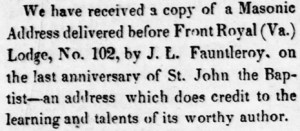
On June 24, 1842, the lodge had an address delivered by J. L. Fauntleroy during the anniversary of St. John the Baptist.
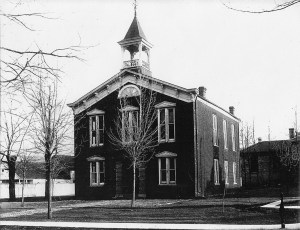
Sometime in 1843, the lodge was located in the Court House and moved to the Odd Fellows Hall.
July 21, 1842
Court House 1904
Warren Heritage Society
Warren Heritage Society
Court House
During the period of 1845-1847, the meetings were sporadic. This Lodge continued to meet at the Odd Fellows Hall until June 16, 1851, the last meeting recorded.
On June 24, 1851, the lodge celebrated the anniversary of St. John the Baptist and invited all local and traveling brethren via the Alexandria Gazette to attend.
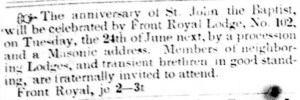
The Grand Lodge of Virginia declared this Lodge extinct in 1857.
Railroad
1854
Rail service was established between Manassas and Riverton, and extended to Strasburg just before the first battle of the Civil War took place in Front Royal.
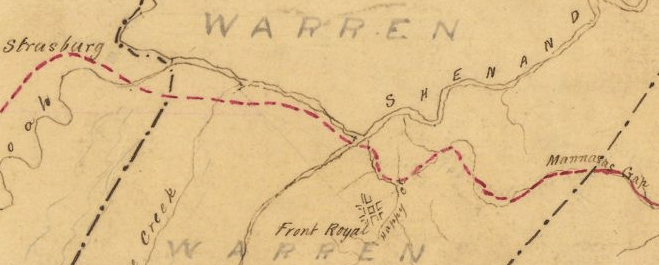
War Department Office of the Chief of Engineers, 1851
National Archives
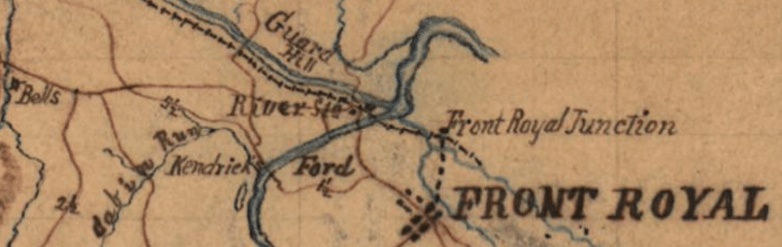
Hotchkiss Map Collection
Library of Congress, Geography and Map Division
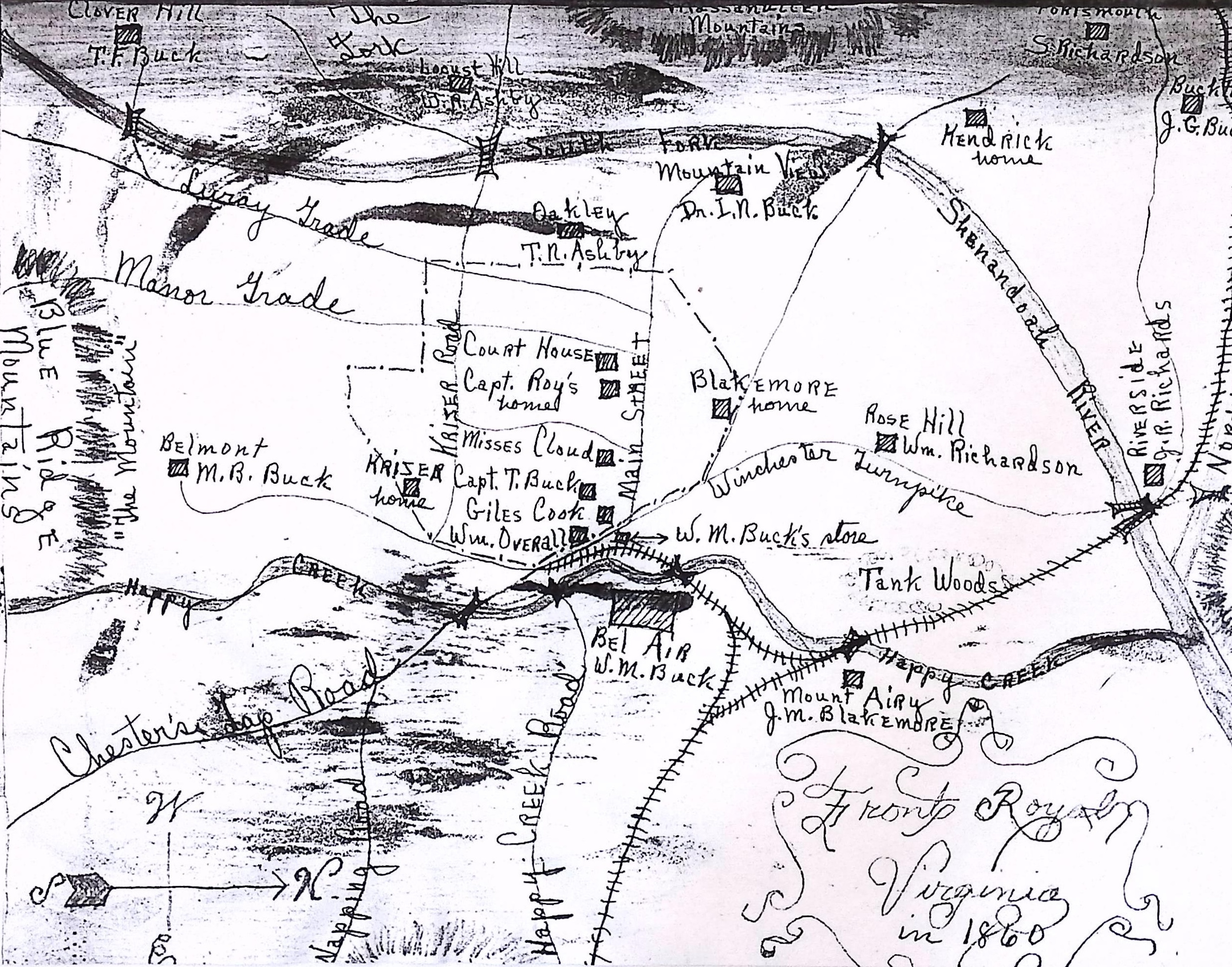
Warren Heritage Society
Civil War
April 1861 – April 1865
Virginia Succeeded from the United States in 1861, while many western Virginia leaders organized to remain loyal to the federal government, eventually reaching across the Allegheny Mountains for support. Today, Front Royal sits about ten miles from the West Virginia state line.
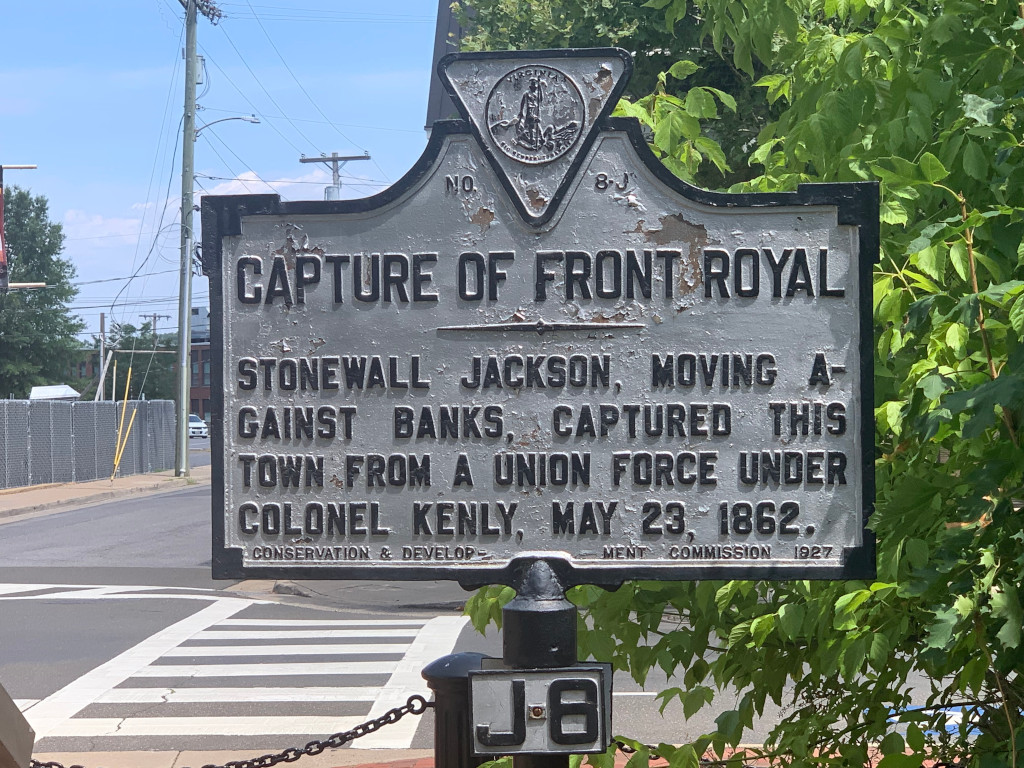
Capture of Front Royal
The towns position in the Northern End of the Shenandoah Valley resulted in many troops passing through and around Front Royal. It became known as the Breadbasket of the Confederacy. Stonewall Jackson started his campaign in the Shenandoah Valley in Front Royal which became known as “The Battle of Front Royal” taking place on May 23, 1862.
Most buildings and records in Front Royal were destroyed at this time. The local train station was destroyed and later restored sometime before 1885. The two bridges over the twin forks of the Shenandoah River were rebuilt in 1892.
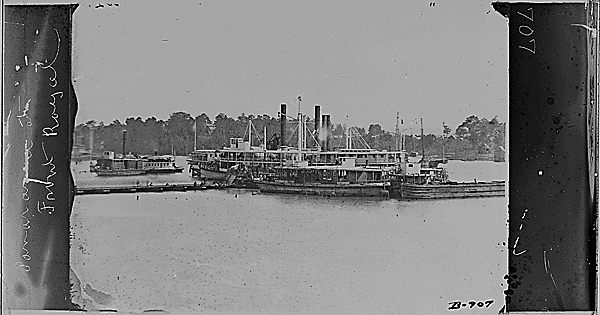
Circa 1860-1865
National Archives
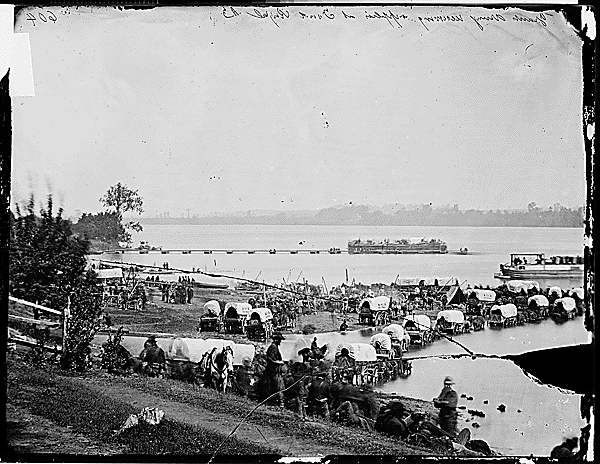
Circa 1860-1865
National Archives
The question is often raised as to the attitude of Masonry during the Civil War and whether or not dissension, and difference of opinion among the members had any influence on the members of Front Royal Lodge No. 102. Fifteen years passed and no records of any Masonic activity can be found.
There were a few masons in Unity Lodge No. 146 formed afterwards that were known to have served in the confederate army. Having been chartered during the reconstruction era, the Lodge and its members played vital parts to rebuild the town and improve the community.
It was reported that Alexander R. Newman, who was initiated at Front Royal Lodge No. 102 had fought in the Confederate Calvary, and was still a mason (for 60 years, and thought to be one of the oldest) in 1878.
West Virginia
June 20, 1863
On June 20, 1863, West Virginia became a state.
Unity Lodge No. 146
1870 – Current
| March 14, 1870 | Dispensation |
| March 25, 1870 | Dispensation Presented Academy Building of Front Royal, upper floor |
| October 12, 1870 | Special Communication By-laws copied from Grand Lodge Digest |
| December 3, 1870 | Application for Charter |
| December 13, 1870 | Charter Signed |
| December 24, 1870 | Stated Communication: Charter presented |
| January 3, 1871 | Warrant issued install and set to work |
| January 18, 1871 | Special Communication elections and officer installation |
At a meeting at the Academy of Front Royal on March 25, 1870, the Grand Lodge of Virginia presented a dispensation dated March 14, 1870, to Unity Lodge No. 146 to hold Masonic meetings. In October 12, 1870, the initial by-laws were a direct copy of the Grand Lodge Digest.
The lodge was chartered on December 13th, 1870. Two days prior to the presentation of the charter, John D. Weaver bought the old Front Royal Academy on December 22nd.
Meetings were held on the Saturday preceding the full moon, or on that night when the moon was full. Electricity was not common in those times. In it’s first year alone, seventeen applicants were raised to the sublime degree of a master mason, and fifteen additional master masons affiliated with the Lodge.
Charter Members
| Thomas N. Ashby 1 | John N. Buck | George W. McCormick |
| Thomas A. Ashby | Thomas W. Buck | Thomas W. Petty |
| Ewell Baker 1 | Charles A. Brown | Gibson E. Roy |
| William Batthus 1 | Charles W. Fisk | Thomas Roy |
| Thomas A. Blakemore | Thaddeus Haynie | Walter S. Roy |
| John W. Boone | Thomas A. Hoffman | Green B. Samuels |
| Alvin D. Buck | James T. Hope 1 | A. E. Senseney |
| Jaquilin Buck | David A. Jones | Smith T. Turner |
| George W. Leach |
1: Former Member of Front Royal Lodge No. 102
Meetings continued to be held on the upper floor of the Old Front Royal Academy Building until March 8, 1873.
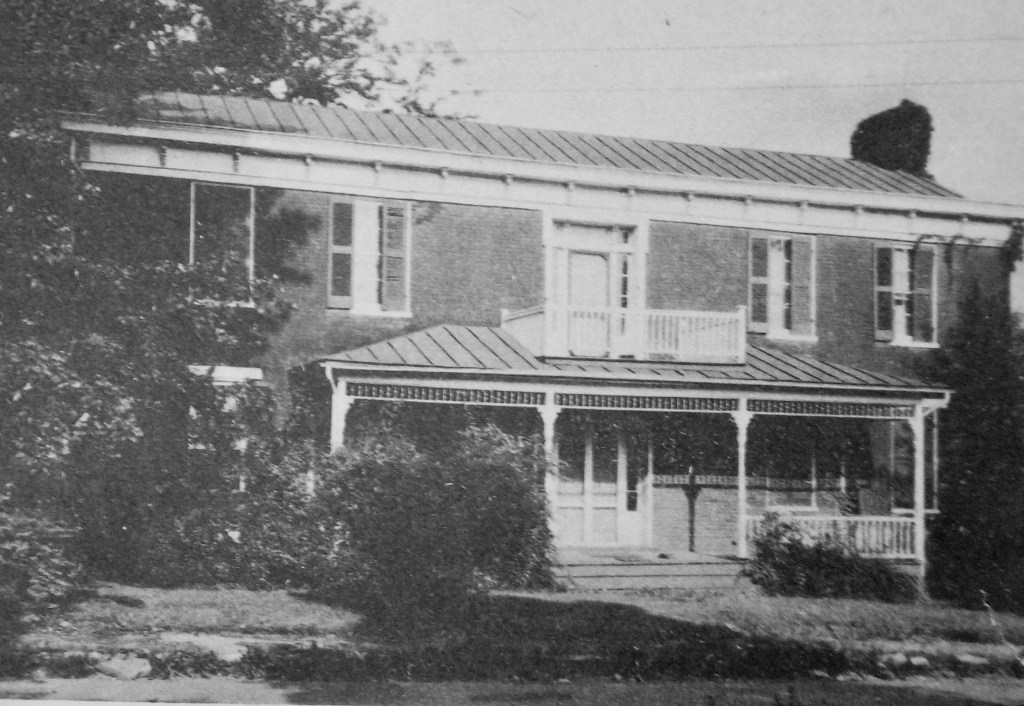
Warren Sentinel, September 19, 1940
Warren Heritage Society
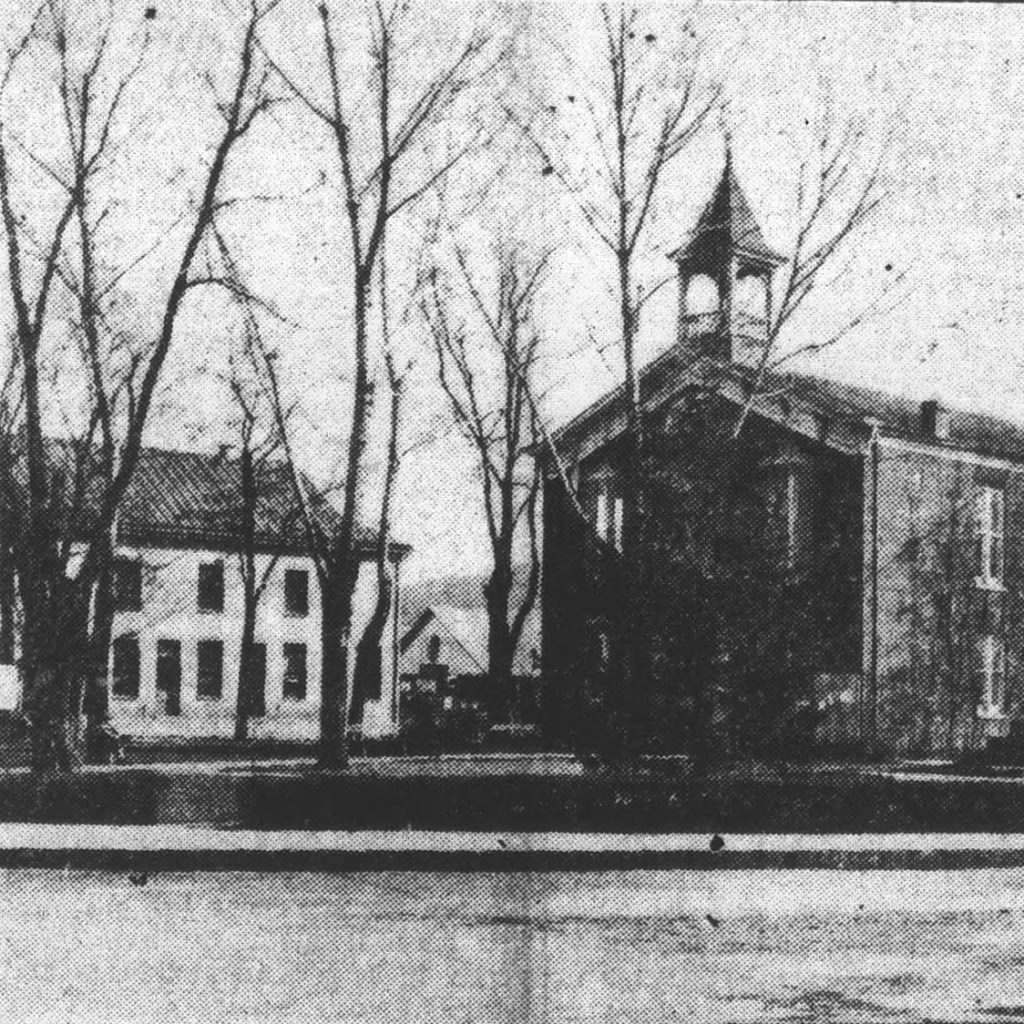
The Old Front Royal Academy was also known as Simpson Academy (taught by Samuel Simpson) located on Crescent Street in a two-story, five-bay brick house that served as a hospital for soldiers during the civil war and as a primary school operated by the Weaver Family. It also referred to as the Atwood house until it was destroyed. Today it is the location of a parking lot with a drive-in ATM.
Mont-View Hotel
Fristoe Hall
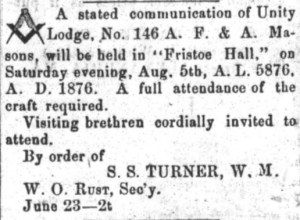
July 28, 1876
A room belonging to Gibson E. Roy was rented yearly for $50. In March 1874, a room was rented from M. T. Fristoe for $75/year and referred to as “Fristoe Hall”. It was located at the Fristoe Hotel, later named Mont-View Hotel. Today the building is known as the Afton Inn. In 1875, the Odd Fellows jointly shared the same room and rental.
Public Free School Building
Union Hall
As a school building was being erected in 1876 during Americas reconstruction era. A contract was made with the builder C. A. Macatee, to add a third story at a cost of $1,000 for use by both the Masons and Odd Fellows. Afterwards, two additional secret orders were included. Now known as “The Old School Building” (aka the Stickley Building and Odd Fellows Hall), is located at 21-23 South Royal Street across from the court house.
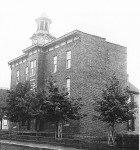
High School 1936
Warren Heritage Society
- Unity Lodge No. 146 of Ancient York Masons
- Front Royal lodge No. 35 of the Independent Order of Odd-Fellows
- Senedo lodge No. 47 of the Improved Order of Red Men
- Front Royal council No. 141 of the Friends of Temperance
The Lodge was responsible for the rent being paid to the School Trustees and collected rent from the other three secret orders. This proved to be inconvenient.
On March 5, 1877, the Virginia General Assembly acted (Acts of 1876-7 Ch 126) to approve a lease made between Front Royal School Trustees and four secret orders on October 7, 1876, including Unity Lodge No. 146 to erect and lease a third story onto the public free school building for 99 years, which was located at 21-23 South Royal Avenue. The lodge hall was in use starting between May and July 21, 1877 until 1907. The room was called “Union Hall”.
School Repair Costs
A further act by the Virginia General Assembly on April 22, 1882 (Acts of 1881-2 Ch 118) amended the previous act to hold all four secret orders jointly responsible to pay a third of repair costs and renewals of the roof and cupola.
Electricity
Electricity was procured for the Lodge in the Autumn of 1892, for the sum of $1.25 per quarter by Royal Heat, Light, and Power Company.
100 Years of Freemasonry
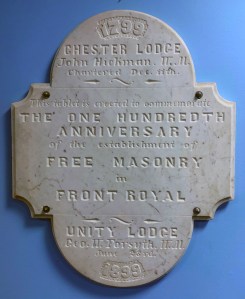
in Front Royal
Geo. W. Forsyth met a gentlemen while smoking at the Grand Lodge and struck up a conversation and discovered that there was a lodge prior to Front Royal No. 102, existing in 1799. The brother displayed a demit from his grand-father. Once Brother Forsyth returned to Front Royal, preparations were made for a celebration.
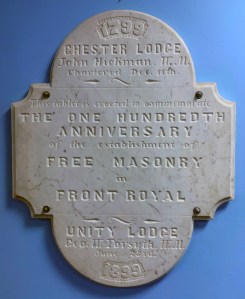
On June 23, 1899, the Worshipful Master presented a marble stone to commemorate the one hundredth anniversary of the establishment of Freemasonry in Front Royal Virginia starting with Chester Lodge.
Note: May have been June 24, 1899.
Open House
Davis Hall
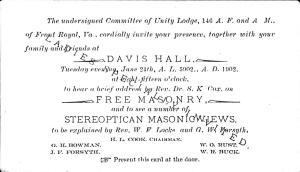
June 24, 1902 at Davis Hall
Warren Heritage Society
On June 24, 1902, a recently purchased steroptican (a slide projector that transitions between two slides) was used to display slides depicting the emblems and symbols of Free Masonry during an open house at Davis Hall. The significance of the slides were explained by two brothers Rev. W. F. Lock and George W. Forsyth, followed by a short address on Masonry by Rev. Dr. S. K. Cox. Refreshments were served in the Davis Hall and ladies were invited to the event.
Telephone Service
1904
Front Royal and Riverton receive telephone service. In the same year, the Electric Light Plant is constructed and serves both Front Royal and Riverton.
Royal Arch
In October of 1904, and invitation was extended to a proposed organization of a Royal Arch Mason Chapter to share the Lodge rooms, and later accepted.
School’s Out
Sometime in 1906, the Oddfellows moved to their own building. In 1907, the School Building was no longer used.
The School Building was sold at public auction to the Odd Fellows who refused to rent to Unity Lodge.
A resolution was passed to take $10 from each initiation fee and put it in a special account for a building fund.
Grand Masonic Carnival and Bazaar
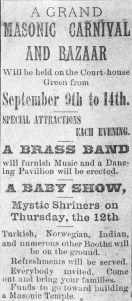
The Lodge had a Masonic Carnival and Bazaar at the court house on week of September 9, 1907 in order to raise funds for a new temple. Many committees were formed to make arrangements.
There were many attractions presented such as minstrels, a brass band, dancing pavilion, and a baby show along with the anticipated arrival of the Mystic Shriners on a pilgrimage via train on the 12th. Special attractions were arranged each evening.
Street Attractions
- Streets of Cairo
- The Midway
- The Warpath
- Turkish
- Norwegian
- Indian
- Swiss
- German
- Irish
- Japanese
Committies
- Bazaar Committee
- Gen. Publicity, advertising, and printing
- Reception and Speakers
- Entertainment
- Fancy Work
- Refreshments
- Decoration and Tents
- Donations other than fancy work
Postcards of the Masonic Carnival were found in the archives of the Warren Heritage Society.
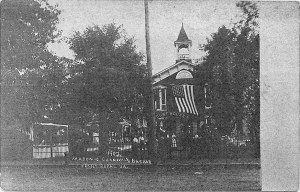
Warren Heritage Society
Masonic Carnival
and Bazaar 1907
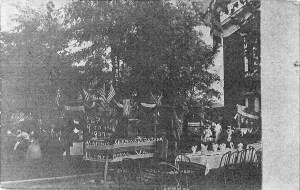
Warren Heritage Society
Masonic Carnival
and Bazaar 1907
Temple Planning
In 1908, the Lodge purchased the Boyd property on the north side of East Main Street across from the Murphy Opera House. In December 1909, the Front Royal Masonic Corporation was formed. An architect was employed for planning a Masonic Temple.
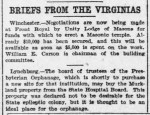
August 29, 1910
In 1909 the Boyd property was offered for sale and the Cass Rust lot on Royal Avenue between the Baptist Church and present (in 1970) Town Hall and Fire Department was bought. The building of a temple was later shelved.
Order of the Eastern Star
On April 15, 1910, the Order of the Eastern Star in Front Royal was instituted.
Murphy Opera House
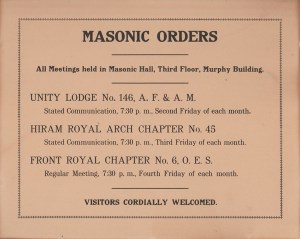
Masonic Orders at Murphy Building
The Lodge moved to a room in the Murphy Block after making arrangements with Brother R. B. Murphy. The first lodge meeting was held on September 16, 1910.
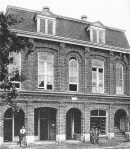
Warren Heritage Society
Murphy Building 1910
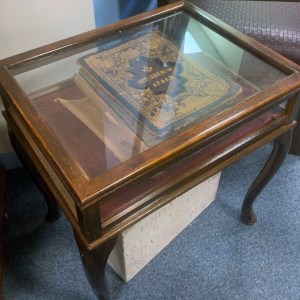
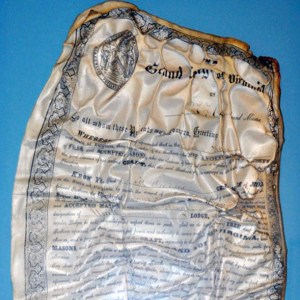
Of particular note was the disastrous fire on Sunday, April 12th, 1914 at 4:30 pm. There are multiple reports on how the first started. One reports that the fire that broke out in the Lodge room on the third floor of the Murphy Opera House, while another says that smoke was coming from the alley between the Opera House and Adams & Co.’s Furniture Store speculating that it was from cigarette stubs thrown into the rubbish.
The fire destroyed much of the Lodge furnishings. One report stated that the Masonic lodge on the third story was completely gutted with a loss of $500, and only $250 in insurance. The charter and Bible were salvaged and both bear mute testimony of the destructiveness of fire. The fire did not reach underlying floors, but there was water damage to the post office, real estate office, grocery store, and dental parlors.
While recovering from the fire, the Odd Fellows let the Masons temporarily return and use their meeting hall until Brother R. B. Murphy could restore the building. Murphy had expressed intent to double the size of the lodge room, and add 30 – 4 feet on the south of the auditorium. The building was insured and Brother Murphy did not think his loss would be heavy.
It took several months to repair. A new stair case was built to the second story in June. Trimmings of the interior of the Masonic Lodge were being put on in July. The lodge was decorated in August. The lodge returned to their room on November 20, 1914.
World War I
July 28, 1914 to November 11, 1918.
In 1915, the Boyd property was later sold to Brother Murphy for $5,000.
Order of the Eastern Star

Warren Heritage Society
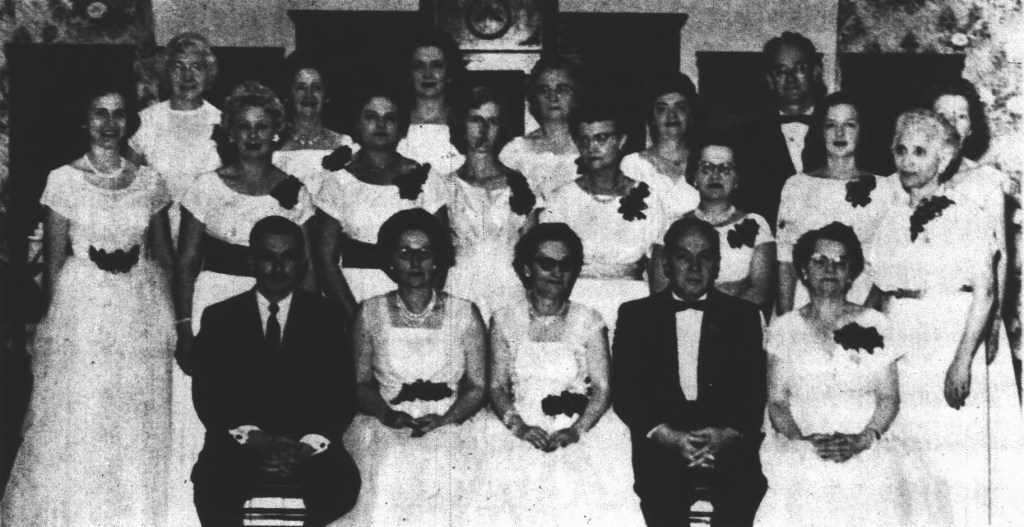
On February 21, 1916, steps were taken to start organizing a local chapter of the Eastern Star. On June 1, 1916, the Order of the Eastern Star, Front Royal Chapter No. 6 received its charter.
The Warren Sentinel, April 5, 1962
Photo: Allen
Warren Heritage Society
Temple Property Search
At the February 22, 1918 meeting, a committee was appointed to inquire about a lot to purchase for the Lodge. Many committees were appointed and discharged as various sites were considered, but then moved to drop the project until February 1921. A lot on Main Street was purchased from W. W. Sonner for $5,000 with bonds that the Lodge held.
Temple Property Search Renewed
The last meeting in the Murphy Building was held on August 14, 1925, and the Lodge returned to the Oddfellows Hall with a rental agreement.
March 25, 1925
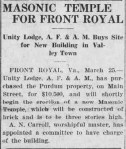
In 1924, a new committee was setup with authority to buy, build, finance, construct, or do whatever it deemed necessary to furnish the Lodge with a suitable Temple without the need to report the progress to the Lodge. The Sonner property was sold for $6,000 and property was purchased from R. E. Purdum for $10,500.
First Masonic Temple
Masonic Hall
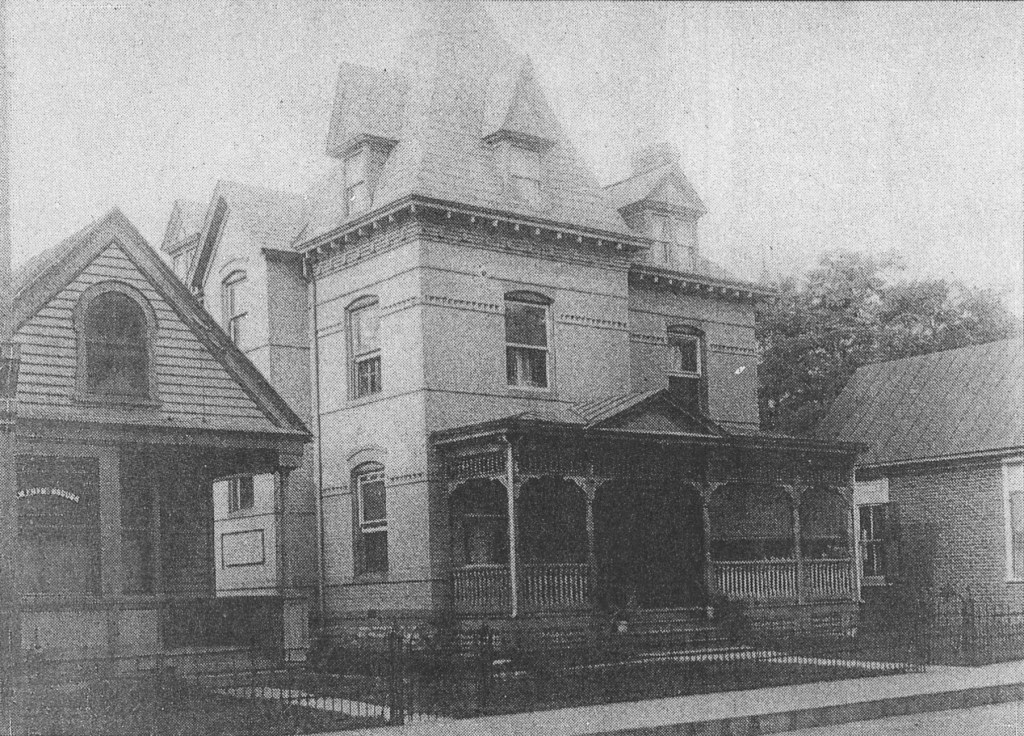
The Warren Sentinel, May 11, 1994
Photo: Circa early 1900’s
Warren Heritage Society
The building, commonly referred to as “Masonic Hall”, was located at 107 East Main Street (GPS: 38.9179, -78.19277). The Masonic Hall incorporated an elaborate late-nineteenth-century, Queen-Anne-style residence into its rambling structure, previously referred to as the Hansbrough House.
A cornerstone was ordered in May and placed on July 29, 1926 by Most Worshipful Charles H. Callahan, Past Grand Master who was representing Most Worshipful Ben W. Beach, Grand Master with many brethren from visiting lodges and dignitaries present.
The first floor of the rear addition was also used for government associated offices. The offices facing the courthouse green were often referred to as “lawyers row”.
Restoration of Lodge History
Worshipful Master Z. J. Compton appointed brothers A. N. Carroll, Jos. L. Borden and George N. Buck to restore the Masonic History of Unity Lodge to the Lodge room on February 12, 1932.
June 23, 1933
World War II
September 1, 1939 to September 2, 1945
Two Rivers Chapter of DeMolay
February, 1944 – July, 1944
For a brief period, the Two Rivers Chapter of the Order of DeMolay was organized and operated out of the Masonic Temple from February 10, 1944 to July 13, 1944. They met twice a month on Thursday evenings.
Temple Improvements
In April 10, 1953 two rooms in front of the temple on the second floor, formerly occupied as an office and waiting room by Dr. Elizabeth Sherman, were remodeled. An air conditioner was installed in the Lodge room, and three bathrooms built and installed (two on the second floor, one on the first floor).
Modernize Temple
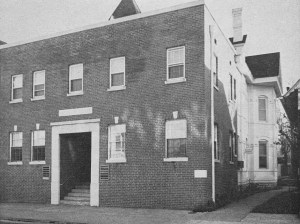
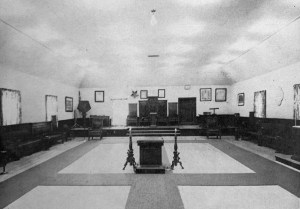
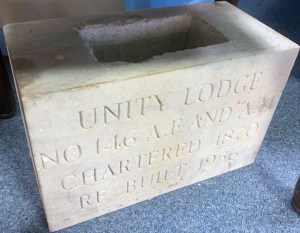
On September 14, 1956, the Lodge had authorized the trustees to erect an extension to the front and rear of the building to install offices. The building would extend 18 feet closer to Main Street and eliminate the front porch to give become a more modern building. Tentative plans were to build a banquet hall at the rear.
Once construction was completed, permission could not be obtained from the Grand Master of Masons in Virginia for a Masonic ceremony to lay the cornerstone, so it was laid without ritual and without many of the members present.
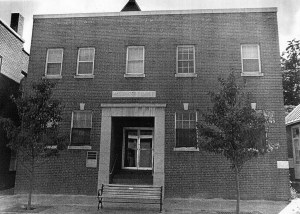
Masonic Temple
Centennial Observance
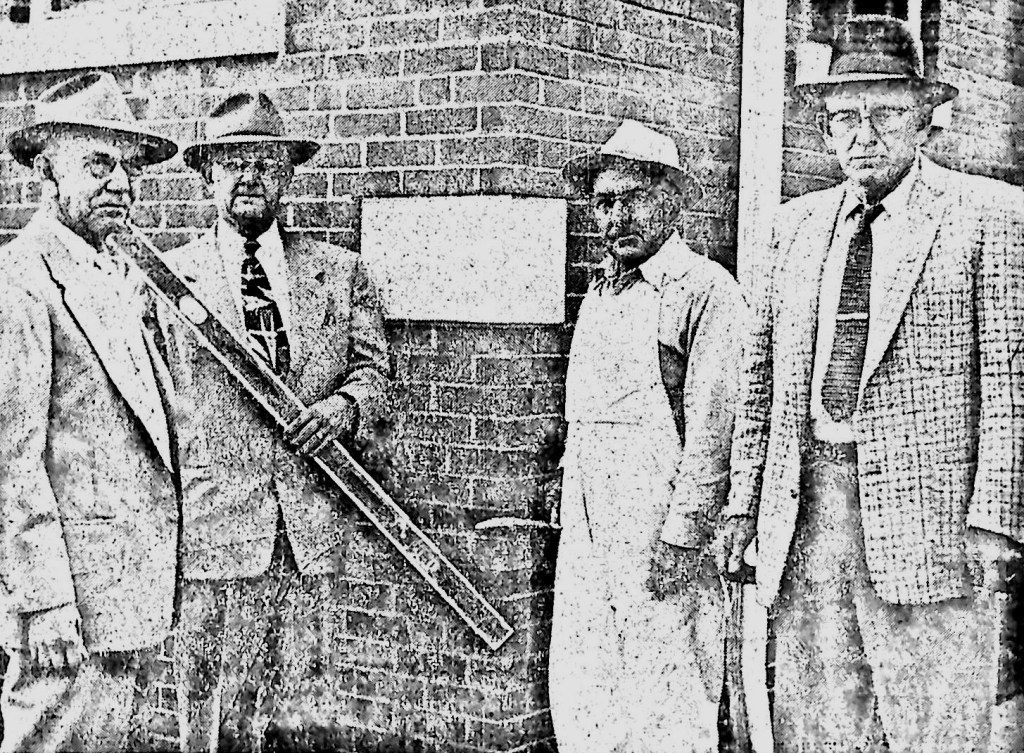
Northern Virginia Daily, Friday 1956
Photo: Morrison
Warren Heritage Society
The offices in the back were used by the Warren County Government, and often referred to as “Lawyer’s Row” since it was adjacent to the court house.
100th Anniversary
On December 5, 1970, Unity Lodge celebrated its own one hundredth anniversary, with enthusiasm at the Beef Cattle Research Station. A centennial plaque was unveiled at the special communication. A booklet (Centennial Observance) was created by a brother documenting the history of the lodge over the past 100 years, and the prior lodges in Front Royal before it was chartered.
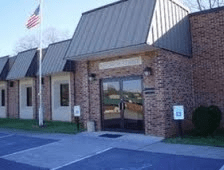
Second Masonic Temple
During 1988 the property was sold to the Warren County Board of Supervisors for $240,000, and a suitable piece of property on Criser Road was purchased from Brother E. Eastham, M. D., for the amount of $50,000.
Through the efforts of Right Worshipful James M. Coverstone and the trustees, Ronald Bean, Clyde Magee and William “Bill” N. Wood, the details of constructing a new building were completed and a new building was erected.
The blueprints were based on a plan that many Masonic temples were built from.
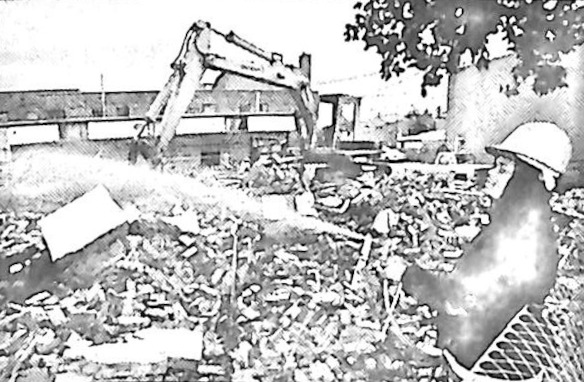
Masonic Hall Demolition
October 1997
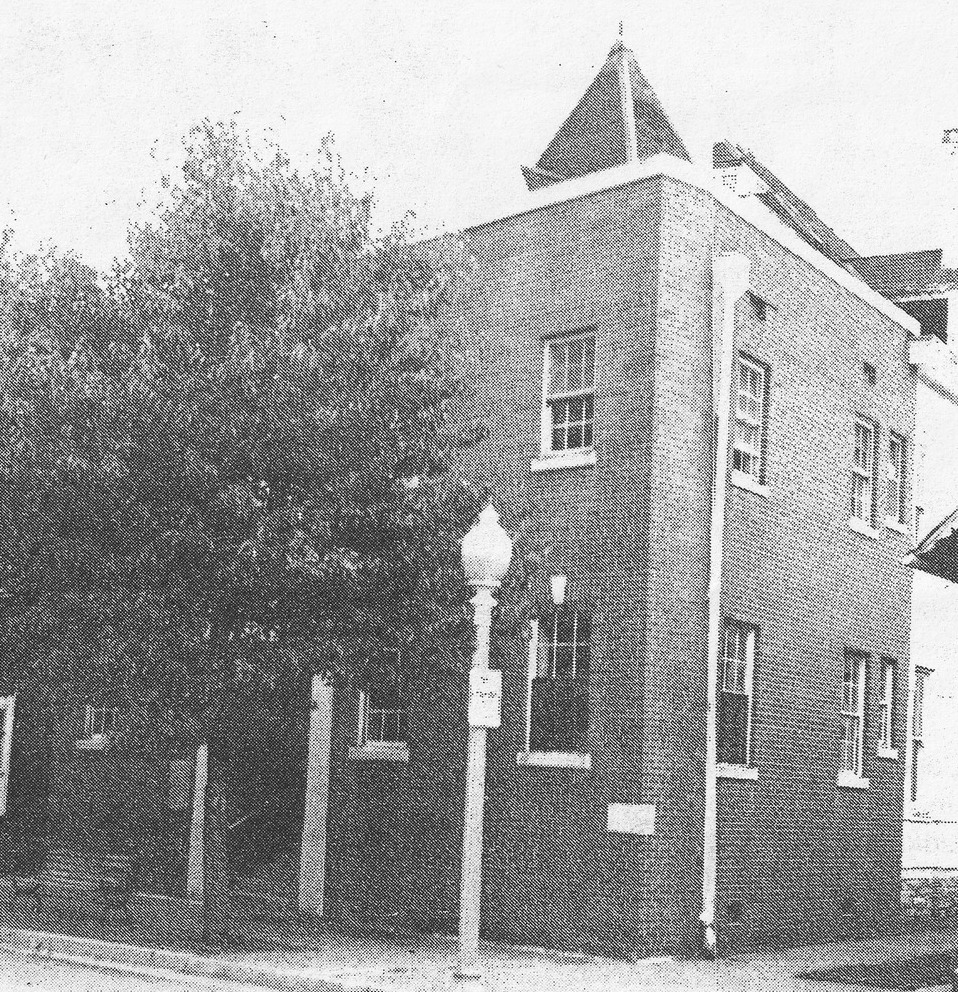
The Warren Times, October 4, 1997
Photo: A. J. Buraker
Warren Heritage Society
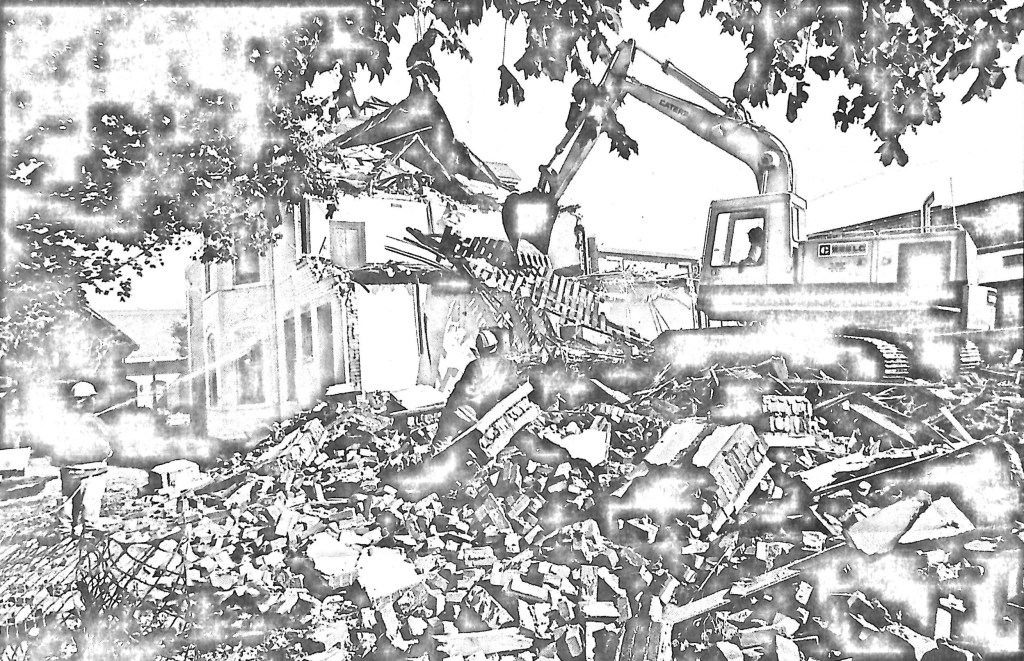
Front Royal, October 30, 1997
Warren Heritage Society
Front Royal, October 30, 1997
Warren Heritage Society
In June of 1997, the Warren County Board of Supervisors decided to demolish the Masonic Building on Main Street to create a 17,500 square foot building, expandable to 27,300 square foot at a later time to support government functions at the Court House next door. On October 13, 1997, Charlie’s Wrecking Service began demolishing the old Masonic Hall on Main Street as well as Bullock’s Cleaner’s building.
9/11 Twin Tower Attack
September 11, 2001
Terrorists hijacked four commercial airliners, crashing into the Twin Towers of the World Trade Center, the Pentagon, and a last crashed into a field after the passengers revolted.
Information Age
In January 2006, a website was setup for https://www.unity146.org.
Social Networking
In November 23, 2010, a public Facebook page was setup Facebook.com/UnityLodge146. On November 5, 2021 a private Facebook group was created for Unity Lodge No. 146 members and fellow masons.

Shenandoah Valley Chapter of DeMolay
Unity Lodge No. 146 and Spurmont Lodge No. 98 cosponsored a the Shenandoah Valley Club of DeMolay. It operated out of the Front Royal Masonic Temple and met on the first Sunday of each month at 4pm starting May 5, 2019. It wasn’t able to get enough members to officially become a chapter and the safeguards put in place preventing meetings due to the global pandemic of COVID-19 had been it’s demise.
Knights Templar

On December 23, 2019, the Luray Commandery No. 19 had its by-laws request approved to hold stated conclave meetings to be moved to the Front Royal Masonic Temple.
With the new appendant bodies of Commandery and DeMolay this year, the Lodge was flourishing and abuzz with activity.
150th Anniversary
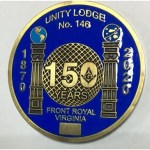
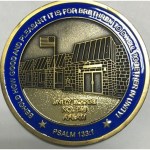
For the Lodges 150th anniversary, the Worshipful Master, Charles Taggart had 150 challenge coins struck and sold for $10 each in January 2020. In addition, lapel pins were designed, also signifying the 150th anniversary.

COVID-19 Global Pandemic
January 20, 2020 to May 11, 2023
After a few years, the Lodge was able to retrieve the traveling gavel from Washington Lodge No. 78 in February 2020, which would remain their for awhile during lock-down. The Lodge had a Past Masters Night at the March Stated Meeting prior to March 15, 2020 where Lodge meetings and Masonic activity were suspended due to Coronavirus (COVID-19). There were two candidates and a few petitions waiting during this time. This was also the end of the Shenandoah Valley Chapter of DeMolay.
On July 1, 2020, the Lodge was permitted to resume stated communications and use of buildings for other activities, but with many restrictions and temporary changes to rituals and operations to promote health & safety. One of the restrictions only allowed up to 10 people to attend a meeting indoors. It was noted that brothers appeared a bit apprehensive to give handshakes at the time.
Quarry Lodge
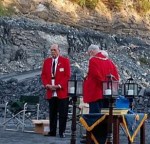
The Lodge received a dispensation to hold a stated meeting at the Leigh-Hanson Quarry in September 2020. Worshipful Charles Taggart invited the Royal Arch Masons and the Most Excellent Raymond Steele presented the program. The brethren present were allowed to bring a new rough ashlar from the quarry as a memorial for the 150th anniversary.
Over time, additional restrictions were lightened and lifted. In June of 2021, Community Breakfast meals returned, virtual meetings for appendant bodies discontinued, and the first conferral took place on June 16th for an Entered Apprentice. On June 17, 2021 remaining restrictions were lifted for degree work.
Knights Templar
In October of 2023, the Knights Templar Commandery renamed itself from Luray Commandery to Jeffery Glen Burnham Commandery.
 Unity Lodge No. 146
You must be logged in to post a comment.